Autonomy in Surgical Robotics

Intelligent control and machine learning that bring autonomy to surgical robots

OverviewApplications
Robotic SurgerySoft Tissue SurgerySkill-independent procedures

Bringing autonomy to surgical and endoscopic robots can reduce the skill required to perform complex procedures, improve consistency and widen access to high-quality care. We develop the perception and control methods that make this possible.

Using computer vision and machine learning, our systems interpret the live endoscopic view and steer toward a target while respecting the constraints of delicate anatomy. Autonomy is always shared: the robot handles moment-to-moment navigation, and the clinician can intervene at any time.

We leverage the generous donation of two Da Vinci® surgical robots from Intuitive Surgical, both equipped with daVinci Research Kits, to validate our research. One of our robots is strategically placed in the University of Leeds Anatomy Lab and benefits from access to soft-tissue human cadavers, making it a perfect setup to perform pre-clinical studies.
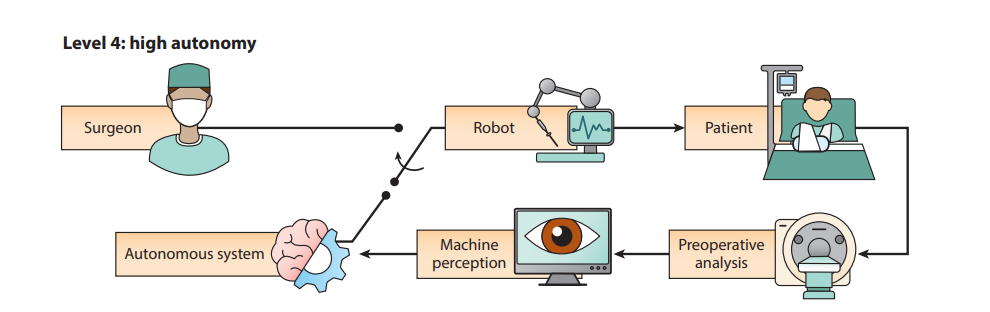
Autonomy in surgical robotics
Relevant publications [12]
  1. 01
    Multiscale deformable objects manipulation via wavelet-decomposed boundary element method
    J. Hu, D. Jones, M. Melibary, et al.
    The International Journal of Robotics Research Apr 2026 doi:10.1177/02783649261441639
  2. 02
    Autonomous robotic exploration of unknown soft objects
    J. Hu, D. Jones, G. Loza Galindo, et al.
    The International Journal of Robotics Research Feb 2026 doi:10.1177/02783649251415415
  3. 03
    NeeCo: Image Synthesis of Novel Instrument States Based on Dynamic and Deformable 3D Gaussian Reconstruction
    T. Zeng, J. Hu, G. L. Galindo, et al.
    IEEE Transactions on Medical Imaging Dec 2025 doi:10.1109/TMI.2025.3648299
  4. 04
    SurgRIPE challenge: Benchmark of surgical robot instrument pose estimation
    H. Xu, A. Weld, C. Xu, et al.
    Medical Image Analysis Oct 2025 doi:10.1016/j.media.2025.103674
  5. 05
    Real-time surgical tool detection with multi-scale positional encoding and contrastive learning
    G. Loza, P. Valdastri, S. Ali
    Healthcare Technology Letters 2024-04 doi:10.1049/htl2.12060
  6. 06
    Occlusion-Robust Autonomous Robotic Manipulation of Human Soft Tissues With 3-D Surface Feedback
    J. Hu, D. Jones, M. R. Dogar, et al.
    IEEE Transactions on Robotics 2024 doi:10.1109/TRO.2023.3335693
  7. 07
    An Ultrasound-Guided System for Autonomous Marking of Tumor Boundaries During Robot-assisted Surgery
    N. Marahrens, D. Jones, N. Murasovs, et al.
    IEEE Transactions on Medical Robotics and Bionics 2024 doi:10.1109/TMRB.2024.3468397
  8. 08
    Towards Autonomous Robotic Minimally Invasive Ultrasound Scanning and Vessel Reconstruction on Non-Planar Surfaces
    N. Marahrens, B. Scaglioni, D. Jones, et al.
    Frontiers in Robotics and AI 2022-10 doi:10.3389/frobt.2022.940062
  9. 09
    Autonomy in Surgical Robotics
    A. Attanasio, B. Scaglioni, E. De Momi, et al.
    Annual Review of Control, Robotics, and Autonomous Systems 2021-05 doi:10.1146/annurev-control-062420-090543
  10. 10
    A Comparative Study of Spatio-Temporal U-Nets for Tissue Segmentation in Surgical Robotics
    A. Attanasio, C. Alberti, B. Scaglioni, et al.
    IEEE Transactions on Medical Robotics and Bionics 2021-02 doi:10.1109/TMRB.2021.3054326
  11. 11
    Accelerating Surgical Robotics Research: A Review of 10 Years with the da Vinci Research Kit
    C. D'Ettorre, A. Mariani, A. Stilli, et al.
    IEEE Robotics and Automation Magazine 2021 doi:10.1109/MRA.2021.3101646
  12. 12
    Autonomous Tissue Retraction in Robotic Assisted Minimally Invasive Surgery - A Feasibility Study
    A. Attanasio, B. Scaglioni, M. Leonetti, et al.
    IEEE Robotics and Automation Letters 2020 doi:10.1109/LRA.2020.3013914